Showing posts with label Music News. Show all posts

Sunday, 22 December 2024

Gigs 2024

When we moved out of the city, I thought I would go out less, and write more. Don't know about the 'going out less'. 

Gigs attended in 2024 (44)

02/02 – Mary Ochre / Whelan's

09/02 – Jah Wobble / Whelan’s

29/02 – ØXN / Vicar Street

25/03 – Sunn O))) / NCH

29/03 - Mohammad Syfkhan / Bello Bar

13/04 – Muireann Bradley / Whelan’s

28/04 – Kelly Moran /Pavillion

29/04 – Cass McCombs & Steve Gunn / Grand The Grand Social

04/05 – Mitski / 3Arena

07/05 – Dan Stuart / Whelan’s

09/05 – John Cummins (Cassandra Voices) / Fumbally Alley

10/05 – Hurray for the Riff Raff / Button Factory

11/05 – John Bramwell (I AM KLOOT) / Grand Social

12/05 – Acid Mothers Temple / Workman’s Club

25/05 – Richard Hawley / Olympia

28/05 – Dr. Sean Millar / Whelan’s

08/06 – Lankum (In The Meadows) / Royal Hospital Kilmainham

15/06 – Stockhausen / Dundalk

28/06 – Patti Smith / Vicar Street

16/07 – Stefan Murphy & Gary Louris / Whelan’s

20/07 – Muireann Bradley / Liberty Hall

01/08 – Waxachatchee / Vicar Street

10/08 - Poor Creature / Bello Bar 

13/09 – The Bad Names & YOP & Creepy Future / Anseo

18/09 – The Last Dinner Party / Telegraph Building, Belfast

26/09 – Martin Carthy / Unitarian Church

27/09 – Godspeed You! Black Emperor / National Stadium

01/10 – Elvis Costello & Steve Nieve / Vicar Street

03/10 – Joan As Policewoman / Whelan’s

13/10 – Arooj Aftab / NCH

14/10 – Valerie June / Whelan’s

26/10 – A Lazarus Soul / Vicar Street

02/11 – Alan Sparhawk / Opium

06/11 – Meteor Airlines / Button Factory

09/11 – Mohammad Syfkhan & Evicshan / Sugar Club

18/11 – Punks Listen Magazine Launch / Whelan’s

19/11 – Idles / Olympia

23/11 – SACK / Button Factory

26/11 – Kelly Moran – NCH

26/11 – ANOHNI Sings Lou Reed / NCH

10/12 – Julia Holter / Button Factory

13/12 – The Blades / The Academy

19/12 – Soft On Crime & Big Tears & Creepy Future / Anseo

20/12 – One Leg One Eye & Imbibe / Project Arts Centre


Thursday, 3 October 2024

Joan As Policewoman Interview - Magill, April 2007

Joan As Policewoman

With Real Life, Joan Wasser – a.k.a. Joan As Policewoman – released one of the more creditable albums of last year, and she’s back in town again (Tripod, Sunday, April 15th). Speaking to me from her hotel room in Austin, Texas, where she has just played one show last night and is doing another one tonight, at South By South West, the “Big schmooze-fest for the industry, if you can live with that” as she puts it, she sounds remarkably chipper.

Most publicity about this lady tends to highlight her previous heavyweight connections. Apart from dating the late Jeff Buckley and singing backing vocals with Lou Reed, her glitter-covered, five-string, violin-cum-viola provided the rhythmic thrust alongside the guitars in loud serrated bands The Dambuilders, Those Bastard Souls (fronted by Grifters’ guitarist David Shouse with Joan, Steven Drozd from The Flaming Lips and Fred Armisen of Trenchmouth) and Black Beetle. Then she decided to go it alone, but her pal Antony Hegarty asked her to join his fledgling Johnsons, and she stayed for years, right up until Rufus Wainwright asked her to join his band and be the support act. A case of always the bridesmaid, never the bride? 

“Well, I wasn’t pining away. I was happy playing my violin, but after awhile I felt I needed to branch out, because being an accompanist wasn’t doing it for me completely anymore. So, I learned how to play guitar, which meant I could start writing songs, because you can’t write songs on a violin, because it’s essentially like the voice, a one-note melodic instrument. Then I started doing shows, to force myself to finish songs. It’s easy to start songs; it’s more difficult trying to finish them.”

So, it’s been a gradual process. Throughout the evolution, honesty has been the goal. “There’s no point in trying to sound like Billie Holliday or Sarah Vaughan. I mean, there’s an art to a pose, and some people do it very well, but I wanted it to come from inside me. That was scary: would there be anything there? So I had to learn to be vulnerable, emotive in front of other people. It was amazing.”

She had sung as a child, but when puberty hit she became self-conscious and stopped singing. Which is pretty strange, when you think what an amazing voice she has. But Antony and Rufus were very supportive. Perhaps the key, though, is growing confidence. As she puts it, in therapy-speak: “I like me now.”

She has described her music as a fusion of soul and punk, “Because in both you’re saying what you mean without fear of consequence. One is associated with anger, the other with love. But both are from the heart. Punk was a big influence on me, but I don’t listen to it much anymore. Soul is my favourite type of music, even though I’m not from a southern, churchy background.”

So no problem with the term Blue Eyed Soul?  “None. Some of those albums are my favourite ever – like Bowie’s Young Americans.” The phrase does, after all, encompass Dusty Springfield, and Joan has been called the Dusty of the indie generation. “Oh, she’s the greatest.”

And that name? “I was a fan of Angie Dickenson in the TV series Policewoman when I was a kid. It was more real, and gritty, than Charlie’s Angels. She was a woman alone. Later, I used to dye my hair blonde, and a friend of mine said to me, ‘You’re channelling Angie’.”

She has fond memories of Crawdaddy, where last July she received a birthday cake she shared with the audience, so try to catch her at the bigger venue next door.

First published in Magill, April 2007


Wednesday, 1 March 2023

Song of the Faithful Departed

I recorded two versions of 'Song of the Faithful Departed' by Phil Chevron of The Radiators during lockdown, for a podcast Stefan Murphy was doing. The first song which 'got' post-independence in a nutshell, and the best. Slow one: Fast one: Thanks.

Tuesday, 6 December 2022

Katie Kim - Interview - August 2022

‘Unassuming’ is an adjective that, at first nod, one might be tempted to reach for when trying to describe Katie Kim and her music, as they both tend to partake of tentativeness, reticence and nuance. But just as the musician’s shyness can shield a quietly stubborn commitment to her craft, so too her dreamy work contains relentlessly emotional swells with the power to leave the listener fundamentally changed, as is evident on her new release, Hour of the Ox. As if to exemplify this notion, she tells me that the title comes from a traditional Japanese cursing ritual, Ushi-no-Toki-Mairi, or ‘ox-hour shrine-visit’, so-called because it is conducted during the hours of the Ox (between 1 and 3am – a good time for listening to ethereal music). The practitioner – typically a scorned woman – hammers nails through a straw effigy of the victim impaling it to a sacred tree. The ritual must be repeated for seven consecutive nights, after which the curse supposedly causes the target’s death – but being witnessed in the act nullifies the spell. So don’t go taking anything for granted here.


So, how are you? 


I'm good. I'm gonna say straight off the bat that this is probably the first in-person interview I’ve had in a good few years. So excuse my social anxiety and word soup – if that happens.


No problem. I think a lot of people feel like that after the pandemic.


I had to go to this event in Universal a few days ago. I was just meeting someone for the first time, and it was one of the most difficult conversations to keep going. Because it’s like, how do I converse with people? Again.


How did you get started in music? In Waterford, when you were in school, were you in bands?

I just listened to a lot of music, and my Mum bought me a guitar when I was 14, for my birthday. She taught me a few chords. So I just started. I mean, I’d always written words or poetry or prose or something like that, not poetry really, more prose in little notebooks when I was younger, but never was ever really able to turn it into music until I got my guitar. So then I started writing songs. As soon as I got the guitar, and was able to play like C, D G or something like that.


Was it always by yourself?


Yeah, like a friend of mine I think maybe played guitar with me to begin with, and then with another friend we actually sang together. I would play guitar and she would sing harmonies with me. But mostly alone.


So when you left school, were you just determined to do music? 


I escaped school at 16. Moved out of home. 


That was brave.


It was brave. Fair play to my mother for letting me do it, but she just insisted that I do my Junior Cert and then she let me move out and get a job and try to start playing.


So that was it. Your focus was all on music?


Yes, it was, it’s what I was aiming towards doing: playing music for a living. 


And doing it solo?


I didn't know if it would turn into a band or solo. I mean, when I around 18, I met Terry Cullen of Ten Speed Racer, and he asked me to be in a band with him. So, then we were a band for a long time, and began touring and recording And so that took over. But I was still recording my own music in between.


You moved to New York after the last record, Salt. Why?


I always wanted to move there. I loved it. I’d been there many times, and I had my friends there. There was a really great music scene happening when I was over there. 


You intended staying for longer, but were forced back here by the pandemic?


I was living with two girls, and we were kind of in denial for about two months about the virus. We didn’t have any television in the house or anything like that. So we decided to take out an old telly and plug it in, and we were watching CNN for a few hours. And then everybody decided to scatter and go back to their homes.


You thought you might have been trapped there?


I wouldn't have been able to get any social security over there. So I thought I’d just come back for a while, but it lasted a lot longer than we thought it would. 


So did all this affect the composition of the songs on Hour of the Ox?


No, because we had a lot of the album done by the time I was in New York. Coming home, we just added some extra flourishes to it. 


That was with John Murphy. 


Spud? Yeah.


I like his work a lot, the stuff he’s done with Lankum especially – The Velvet Underground meets Planxty. 


He's fantastic. I'm just so happy because we’ve known each other for so long, like we were friends in Waterford, from when we were teenage kids. I'm just really, really happy for him that he’s finally getting the recognition he deserves because he’s worked really hard over the years.


You were bouncing files back and forth to each other. 


That’s kind of the way we work. I would always write the stuff at home. And I always record the vocals at home as well, like I would never record in the studio with Spud, I would always record them at home, bring them in. But I would send him stuff every now and again, and at some stage in the year, we would decide that we should actually start putting the album together. 


I thought maybe Hour of the Ox is, musically, a bit more accessible than previous albums? Are you conscious of a difference?


I have no idea because the only people that have heard it have been people that are close to me. And I know they’re only going to say nice things mostly. So I have no idea how accessible it is,  yet.


So that wasn’t a conscious decision?


No, I just thought that it would be nice to try and do something new every time instead of trying to go back to the old tropes all the time. I thought that it would be fun this time to get a live drummer in and play around with synthesisers because I've been listening to a lot of soundtracks over the last few years, and people like Clint Mansell, and a lot of stuff that Invada were putting out, a lot of Geoff Barrow’s soundtracks and things like that. So I was really starting to get into that kind of lush synthesiser kind of sound. I wanted to play around with that.


So there is a process of continuing evolution going on?


Well, I haven't really played around with those kind of orchestrations together before, we’d had strings, but I thought synthesisers with strings would be a really nice thing to try and meld together. 


Can you tell the difference between synthesised strings and live strings?


Well, now I can because we had live strings this time.


You strike me as quite determined and single-minded. You’re not going to be side-tracked into doing other things. You’re quite focused.


Do you mean into doing mainstream music?


Not necessarily, just that you’re determinedly sticking at it, doing your own thing.


Look, there’s definitely been times when I’ve just thought, you know, “Fuck this, it’s not going anywhere”, whatever. But that’s not the whole point about doing it. It’s actually quite a big part of what I feel is my identity. And when I have stopped playing or writing or recording for any amount of time, like two years sometimes I’ve gone without doing any of that, it becomes ‘a dark time’ – not a very nice place. Just for me personally – I’m not talking about anybody else’s life – just getting up in the morning and having your breakfast and going to do your job and having to do something else and coming home and going to sleep and repeat the process, it doesn’t really suit my personality very well, I kind of need something else creative happening. So look, even if I make stuff, and I see five plays on it after a year, I’ll still be happy that I made it.


Katie Kim - Hour Of The Ox Album Launch is at The Button Factory, Saturday 10 September 2022


Friday, 25 November 2022

Wilko Johnson R.I.P.

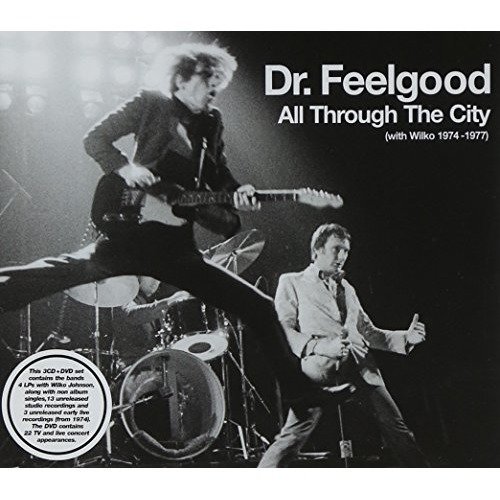
As a further tribute to the late great Wilko Johnson, here's a review of the Dr. Feelgood boxset All Through The City, which I wrote in 2012, for the now-defunct website, State.ie.

Dr. Feelgood

All Through The City (with Wilko 1974-1977)

(EMI)

Desmond Traynor

4/5

As the currently showing BBC 4 documentary series Punk Britannia persuasively hypothesises, the revolution of 1977 was the bastard offspring of the miscegenatious union of r’n’b and glam, when the pub rock and art college scenes met. From the former came most of the music, from the latter most of the look and attitude. Always somewhat Britcentric, the Beep elides the fact that as early as 1973 crazy Yanks like the New York Dolls were wearing women’s clothes while covering Sonny Boy Williamson and Bo Diddley songs. But then again, both Joe Strummer and Ian Dury attended art colleges and played in pub rock bands prior to New Wave apotheosis.

  Around the same time the Dolls were first trying on their high-heeled platform boots, Canvey Island’s Dr. Feelgood were tearing up the London pub scene with incendiary live shows which many seasoned gig goers were saying they hadn’t seen the likes of since the early days of The Who or The Stones. While scruffy off-the-peg suits were favoured as stage wear over silk or satin dresses, the same musical spirit animated them as that of their transatlantic tranny contemporaries. A brief band interview for Finnish television, at the end of the collection of live performances included in this marvelous new 3 CD + 1 DVD boxset of the band’s first four albums, plus unreleased demos, alternative versions, out-takes and live tracks, features the taciturn rhythm section of drummer John ‘The Big Figure’ Martin and bassist John B. Sparks (both of whom looked like burly bouncers you wouldn’t want to meet down a dark alley), the grimly polite singer Lee Brilleaux, and cocky young guitarist Wilko Johnson, who helpfully explains the r’n’b ‘revival’ thus: ‘It’s the best music. People have had six years of synthesisers and songs about hobbits. That’s for girls. People want to have a good time.’ As someone with a degree in Medieval English from Newcastle University, which he shrewdly kept quiet about, as well as considerable musical knowledge and ability, perhaps he was better placed to diagnose the deleterious influence of Tolkien on popular music than many would have given him credit for at the time.  

  They had their precursors, and their peers (Eggs Over Easy, Ducks Deluxe, Brinsley Schwarz, The Kursaal Flyers, Strummer’s 101ers, Dury’s Kilburn and the High Roads – even early Boomtown Rats), but they were the best. This was largely, in my opinion, down to Wilko’s wildly idiosyncratic guitar playing, whose self-confessed primary influence was Mick Green of The Pirates. Yet, although he was operating in a genre which thrives on notions of ‘passion’ and ‘feeling’, Wilko played like a machine, producing a weird r’n’b/motorik hybrid. Like forebears Otis Rush and Albert King, and the closer-to-home Jeff Beck, he eschewed the plectrum, his right hand a freestyle of fingers’n’thumb, conjuring choppy insistent rhythms and angular staccato lead lines, sometimes seemingly simultaneously. There’s less that separates the Feelgoods from Neu than you might think. The Man Machine, indeed. One shouldn’t, of course, overlook the solidness of the rhythm section itself in this process. Razor-sharp time-keeping was still the preserve of human beings in those days. Add to that the pent-up anger and frustration of Brilleaux, a front man who looked like he might hit you as soon as sing to you, which made him the scariest stage presence yet encountered in British live music, and who remained so until a sneering Johnny Rotten swaggered into the spotlight to unbeknowingly inherit his mantle, and the package was complete.

  What’s in the box? CD 1 has Down By The Jetty and Malpractice, both from 1975, the former the excellent re-master of the original mono mix released as a deluxe reissue in 2006 (thankfully still in mono), the latter, like the two albums on the succeeding CD, a new 2012 digital remaster.  CD 2 contains the peak and the valley, 1976’s Stupidity and 1977’s Sneakin’ Suspicion.  Produced, like the first two, by Vic Maile, who’d engineered The Who’s Live At Leeds, Stupidity is their masterpiece, one of the great live rock albums, made by a band who were always most at home in the live context. The rot set in with Sneakin’ Suspicion. Although signed to United Artists in Britain, they wound up on CBS in America, who felt their substantial promotional investment justified foisting their own choice of producer, studio veteran Bert De Coteaux, on the project. This resulted in an altogether too slick sheen to the sound, unsympathetic to a raw band like the Feelgoods. 

  There had been friction between Johnson and Brilleaux anyway. Wilko liked speed, and was partial to acid; the other three were serious drinkers (not that these recreational pursuits are necessarily mutually exclusive, but it proved so in this case). Jealously about ‘residuals’ may have also caused disputes, with Wilko doing the lion’s share of the songwriting. Whatever way you slice it, Johnson played on the album but never toured it, walking out of the sessions and subsequently forming the Solid Senders. As his replacement, the others drafted in John ‘Gypie’ Mayo, a perfectly adequate if rather more conventional r’n’b guitarist, who on later albums only served to illustrate how special Wilko had made Dr. Feelgood. Interestingly, some of the odds’n’sods on CD 3 are demos for Sneakin’ Suspicion, and tracks that were left off it, which show what a good album it could have been if the band had been left to its own devices. The DVD pulls together a variety of TV appearances (dig those cruel V-neck jumpers on The Geordie Scene’s audience) and live sets from shows at the Southend Kursaal (some of which wound up on Stupidity) and the Kuusrock festival in Finland. The package also includes a recent interview with Johnson, some natty comic strips and pics, plus a revelatory essay about their formative years, ‘The Breeding of Dr. Feelgood’, by poet Hugo Williams. (Another renowned poet, Tony Harrison, was apparently a huge mentor to Wilko at Newcastle, and later a close friend.)

  I saw them once, at the National Stadium in 1976 (don’t worry, I hadn’t even done my Inter Cert, as it was then known, at that stage) unfortunately just after Wilko had left. I saw the Solid Senders some years later, and have seen Wilco several times since. He played Whelan’s not so long ago. Good shows all, but together they must have been somethin’ else.

  The New York Dolls may have beaten their British counterparts to the punch by several years as progenitors of punk, but in this boxset you have a valuable document of one of the antecedents of British New Wave, the other strand of which was being provided by T Rex et al. The Feelgoods and Roxy Music? It’s a strange fusion, but that’s one of the great things about popular music: once you get beyond the fashion, it’s all there for you to choose your own particular pick’n’mix.


Sunday, 29 May 2022

Cathal Coughlan R.I.P.

Of a sudden, I recall that I did a phone interview with the great Cathal Coughlan in 2013, for the now defunct website State.ie, about his North Sea Scrolls project with Luke Haines and Andrew Mueller. Here be the text.


Cathal Coughlan / North Sea Scrolls

What do you get when put Cathal Coughlan, of Microdisney, Fatima Mansions and solo fame, Luke Haines, formerly of Auteurs renown, and music journalist and travel writer Andrew Mueller together in one room? Why, three men in colonial hats and It Ain’t Half Hot Mum jungle suits, singing songs about an alternative history of Britain and Ireland. These gents are bringing their demented North Sea Scrolls show, which started life at the Edinburgh Festival in 2011 and was subsequently released as an album last year, to the National Concert Hall on November 2nd. Cathal Coughlan recently marked my cards as to what to expect, and we chewed over some other old stuff as well.

  Just to fill the unsuspecting among you in, the North Sea Scrolls are ancient documents, long thought forever lost, which were presented to Coughlan and Haines by the actor Tony Allen, who found them in a bin outside Waitrose. They contain a proxy account of the recent past in these isles, demonstrating that pretty much everything you know and have ever learned about them is at best inaccurate, but more likely just downright wrong. 

 Who’d have thought, for example, that far from suffering 800 years of oppression under the English yoke, in reality the Irish invaded and conquered Britain in 1948, later dividing it into just two counties, Northshire and Southshire? Or that Oswald Mosley led two successive British governments in the 1960s, with Joe Meek as his Minister of Culture, while Enoch Powell was Poet Laureate? (Apropos, I’m surprised they didn’t shoehorn Eric Clapton’s once professed admiration for Powell, elucidated drunkenly from a Birmingham stage in 1974, in there somewhere) Or that the failed kidnapper of Princess Anne, Ian Ball, made a Robert Johnson-at-the-crossroads-like pact with the Devil – a gent who appears in a cloud of sulphurous cigar smoke, with a rattle of gold chains, wearing a shell suit – who ‘fixed it’ for the Broadmoor Psychiatric Prison resident to swap places with his guitar-wielding namesake in the ‘bewilderingly successful’ indie rock band, Gomez. (Considering this twist, it’s odd the boys didn’t conjure some similar case of mistaken identity between above-mention thespian Tony Allen, and the identically named great Afrobeat drummer.) 

  Another song, Coughlan's 'Mr Cynthia', puts the record straight on how Joe Meek put a radicalized John Lennon under house arrest in the mid-’60s, to curb the Mop Top’s influencing the country’s impressionable young folk toward dissent. In his absence from the public eye, Lennon’s then wife Cynthia immerged from the shadows into a proto-Thatcherite champion of ‘blank common sense.’ Perhaps unsurprisingly, Jim Corr figures along the way too, persuading the retired IRA to dig up much of South Armagh because he believes that Shergar, the Twin Towers and many other things are buried there.

  The eagle-eyed among you will doubtless have spotted that, unlike how their illustrious predecessors the Dead Sea Scrolls act as an adjunct to official Christianity, the flaw with the North Sea Scrolls is that most of the events recounted therein would still be within living memory. Consequently, feeling that there is little point in quizzing Cathal as to the veracity of these claims, I inquire instead as to how he views the revelations of the scrolls in relation to the rest of his fine body of work. C’mon, isn’t it all just a humorous diversion, a Flann O’Brienesque jeu d’esprit?

  “It’s not just a bit of fun,” Cathal responds. “I like to think it’s visionary, but not very serious. It’s also not always necessarily me speaking with my own voice. I’m so distant from Ireland now, that my view of Ireland can be inaccurate anyway. But in the past I might have come over as too po-faced sometimes, so it’s nice to do something more tongue-in-cheek.”

  Which does cast into question if there’s any sense on the part of the writers, on the one hand, directing their considerable ire at soft targets like Gomez or Chris Evans (who gets burned at the stake), or in the audience, on the other hand, getting hot under the collar about a universe where Gomez and Chris Evans come off worse than Mosley and Powell. We all have our pet hates – don’t get me started on The Killers – but there again, would I bother writing a song slagging them off? Are the fairly innocuous actually more reprehensible than the outright awful? And what happens when the former are lampooned more than the latter? 

  Of course, Cathal is not entirely responsible for this state of affairs, as he and Luke Haines divide the songwriting credits, and vocals, between them. So, how did he meet Luke Haines? How did he work with him? Do they have an affinity?

  “Well, Luke has most of the punch lines. I’m a kind of foil to him. He supplied most of the English stuff, and I took care of the Irish angle. The songs were written over a nine month period, and it was nice to meet up every so often and just hatch songs. I’d bring what I had, he’d bring what he had. I’ve known him for seven or eight years. I’m certainly a fan of Luke’s, you’d have to ask Luke if he’s a fan of mine.”

  They are both lyricists – why do they need Andrew Mueller’s input?

  “He provides the narration, and some historical context. He brings a certain kind of Australian irreverence. He’s also an editor of sorts.”

  In his younger days across the water, Cathal was known for his antipathy towards the raggle taggle brigade back home. In the nascent days of Fatima Mansions in the early ’90s, he was heard to ask and answer from a London stage, “Am I the only person here with an Irish passport who doesn’t think Van Morrison is a god-like genius? Transatlantic fraud.” This was in the wake of the huge success of the Morrison/Chieftains collaboration, Irish Heartbeat. Might his Van ‘Grumpy’ Morrison comments be seen as kicking against perceived regression after the advances of the punk wars had dissipated? Or against perceived misrepresentation of Ireland on the international stage?

  “I hated that album, I hated it more than normal because I even paid for it with my own money. But I have to say I think Astral Weeks is a great album, particularly when you think how young he was when he did it. Looking back now, I think people find all kinds of reasons for why they don’t like something - the politics, the ideology, whatever - but there’s usually a more fundamental reason: they just don’t like listening to it.

 “It’s funny, when I started listening to English folk music, and discovered it was much more acerbic than Irish folk music, which is much more lush. But I’ve always loved Christy Moore, one of my favourite singers.”

  Would he ever come back to Ireland, or is he firmly ensconced in London now?

  “I’m over four or five times a year. But materially, there’s no way someone of my resources could just walk back into it now. I was skint then back them, I’m not that much better off now.”

  But London’s expensive.

  “But I have a support system here. I know where to go, where things are cheaper.”

  Any regrets about how he handled his earlier career? Would it have helped if he’d been less confrontational?

  “A lot of the problems to do with Microdisney stemmed from insecurity, anxiety. By the time we got to the final album it didn’t seem to matter what we did, because the audience was well and truly alienated anyway.”

  And his solo career?

  “What I learned from making Black River Falls was ‘don’t waste time on little things’. I brought in people to get help with the strings on that, and it dictated the rest of the album.”

  Has he anything in the pipeline now?

  “If I do something, it’s going to be very different from what I’ve been doing recently, or even in the middle term. It won’t have a strong rhythm section, and will feature more string arrangements.”

  Will he be recording?

  “I’ve come to think that making a record is of questionable use, either as a means to playing in public, or for documentation. It doesn’t get you more gigs, at least not if you’ve being doing it as long as me. But we’ll see.”

  Back to more immediate concerns, North Sea Scrolls has been recorded, but has divided opinion, with reviews ranging from ‘deeply engrossing and rings resoundingly with cultural and historical truth’ to ‘a discombulating listen, but also a daft, enjoyable one’ to ‘an in-joke gone horribly wrong.’ With a public interview before the show itself, you can get to explore how seriously or otherwise we should take these phantasmagorical tales, and make up your own mind this Saturday.


Saturday, 18 December 2021

Albums of the Year 2021


1. Floating Points/Pharoah Sanders/The London Symphony Orchestra – Promises

2. Can – Live In Stuttgart 1975

3. For Those I Love – For Those I Love

4. black midi – Cavalcade

5. Mogwai – As The Love Continues

6. Low – Hey What

7. Sarah Davachi – Antiphonals 

8. Arooj Aftab – Vulture Prince

9. Various Artists – Somewhere Between: Mutant Pop, Electronic Minimalism & Shadow Sounds of Japan 1980–1988

10. Joan As Police Woman, Tony Allen, Dave Okumu – The Solution is Restless

11. Viagra Boys – Welfare Jazz

12. Lou Reed – Live At Alice Tully Hall (January 27, 1973 - 2nd Show)

13. Jane Weaver – Flock 

14. John Murry – The Stars Are God’s Bullet Holes

15. Cathal Coughlan – Song of Co Aklan

16. The Hold Steady – Open Door Policy 

17. King Gizzard and the Lizard Wizard – Butterfly 3000 

18. St. Vincent – Daddy’s Home 

19. Ryley Walker – Course In Fable

20. Valerie June – The Moon and Stars: Prescriptions for Dreamers 

Bubbling Under:

Iceage – Seek Shelter; Deafheaven – Infinite Granite; Black Country, New Road – For The First Time; My Morning Jacket – My Morning Jacket; Rhiannon Giddens (with Francesco Turrisi) – They’re Calling Me Home; Robert Plant & Alison Krauss – Raise The Roof; The Weather Station – Ignorance 

Reissues I’ve enjoyed, which are not merely remasterings of the old stuff, but rather feature lots of new material (which means they are mostly live, or the originals were never properly released in the first place), include: Bob Dylan – Springtime In New York: The Bootleg Series, Volume 16 (1980-1985); The Knocking Shop – Half Orphan; John Coltrane – A Love Supreme: Live In Seattle; and Alice Coltrane – Kirtan: Turiya Sings. 

Music Book of the Year: Harry Sword – Monolithic Undertow: In Search of Sonic Oblivion – A virtual Bible, from which I’ve discovered so much good stuff I’d never heard of previously. 


Friday, 12 February 2021

Mavis Staples

An interview I did with Mavis Staples, before her November 2012 concert in the National Concert Hall.

Gospel blues legend Mavis Staples is playing the National Concert Hall on Saturday, November 3rd, as part of a European tour, and I was lucky enough to speak to her before a recent Washington DC date, in advance of the trek across the pond. Considering this is someone who, as the youngest member of The Staple Singers, along with family patriarch Roebuck ‘Pops’ Staples and sisters Cleotha and Yvonne, was in the eye of the Civil Rights Movement maelstrom in the ’60s, with Freedom Songs such as ‘Why Am I Treated So Bad?’,  ‘Long Walk to D.C.’ and ‘When Will We Be Paid?’, I feel a bit like a gushing, weak-kneed teenage fanboy trying to do a passable impersonation of a mature adult in the presence of an idol. The ice-breaker is a question about if she’s been to Ireland before, and what her impressions were.

  “I was there in 1989, I think it was, with Prince. Ireland is so beautiful, so green, and everybody was so friendly. We went to Dublin, and Cork, and I kissed the Blarney Stone.”

   Informed of the local belief that said action can work in reverse, i.e. while it is famous for imparting the gift of the gab to the normally reticent, it can also render the previously loquacious a tad taciturn, she says:

  “Well, it didn’t work that way for me. My sister Yvonne (now one of her backing singers, and her roomie on tour) always says, ‘Mavis, you talk too much and you talk too loud.’ ” As we crack on, the truth of this admission becomes increasingly self-evident. The woman doesn’t need much prompting to launch into story after story, and is not shy about expressing her views.

  Born in 1939 in Chicago, where Pops had migrated from Winona, Mississippi, Mavis began singing in church with her family, aged eight, and attracted attention from the off.

  “We weren’t singing for money in those days, we would just be singing around the house all the time. We used to sing at Aunt Katie’s church. The first time I sang Ms. Vivian Carter from Vee-Jay Records happened to be in the congregation, and she said, ‘Pops, you gotta record these songs.’ But I was only eight, he wouldn’t let me start singing outside church until I was 11. Our first single was a song we sung that day in church, ‘Will The Circle Be Unbroken’.”  It was a best-seller, as was the subsequent ‘Uncloudy Day’.

  The group signed to Memphis-based Stax Records in 1968, joining their gospel harmonies and deep faith with more contemporary sounds. The first two albums, Soul Folk in Action and We'll Get Over, were produced by Steve Cropper, although Mavis is at pains to correct any false impression that they were backed by Booker T. & the MG's: “It was our own band that played on the records.” In 1970 producer Al Bell took them down the road to Muscle Shoals, and things got decidedly funkier. Starting with ‘Heavy Makes You Happy (Sha-Na-Boom Boom)’, The Staples hit the charts 12 times between 1971 and 1975, including two No. 1 singles, ‘I'll Take You There’, and the Curtis Mayfield produced ‘Let's Do It Again.’ By this time, Mavis was carving out a solo career, but the group continued to have hits on the R&B chart into the ’80s, once with an unlikely cover of Talking Heads' ‘Slippery People.’

  Probed about The Staples’ Civil Rights Activism, Mavis recalls meeting Dr. Martin Luther King:

  “We were playing in Montgomery, and we just had to go and hear Dr. King preach at his church. He knew we were there. He acknowledged us at the door of the church, and spoke to us.’

  But how effective is socio-political dissent expressed in music? Can it change anything, or is it just a form of comfort? 

  “You know, I’ve been singing for 62 years, and I remember the first time we were able to drink from water fountains, I felt so proud. We were part of that.”

  Given that she sings songs like J.B. Lenoir’s ‘Down In Mississippi’, which makes direct reference to segregated drinking fountains, and ’99 and ½’ and ‘My Own Eyes’, all from 2007’s Ry Cooder-produced album We’ll Never Turn Back, it’s a bit of a stupid question on my part in the first place. She continues with an anecdote around that record:

 “When I went to meet (former Dr. King associate and current Democratic Representative for Georgia) John Lewis in Washington, because I’d asked him to write the liner notes for We’ll Never Turn Back, he told me: ‘You should be proud, because you helped to bring about all those changes.’ Still, when I look at the news today in Chicago, where I live, I see when black families move into white neighbourhoods, they’re still not accepted. They get ‘the n-word’ sprayed on their cars. So it’s not like that’s all in the past.”

  Incidentally, Lewis’ eloquent liner notes affirm that politically charged music can both contribute to social change, and be a source of comfort during struggle: ‘Back then, some people thought legalized segregation in America would never come to an end. But those of us in the Civil Rights Movement were inspired by a higher calling. And even if it cost us our very lives, "we weren't gone to let nobody turn us `round". We believed that the action of peace, the way of non-violence, and the power of love could overcome our oppression and remind our oppressors of their own humanity. Through the power of this faith our nation witnessed a non-violent revolution of values, a revolution of ideas that changed America forever. 

  ‘The music you are listening to right now was the soul of that revolution. It was this music that gave us hope when it seemed like all hope was gone. It was the heartbeat of this music and its steady, reassuring message that bound us together as one solid force. So when we were beaten, arrested and jailed; when we stood together on picket lines or marched through the streets of the Deep South; when we faced the guns drawn, the billy clubs and the bullwhips raised; when we were teargased, trampled by horses, or scattered by fire hoses, it was these songs that lifted us and pushed us to a higher place. 

 ‘It is my hope that when you hear Mavis Staples, when you hear the Freedom Singers, and the other artists on this CD, that you too will be inspired.’

  So, what about the forthcoming Presidential Election, and the Obama versus Romney debate?

  “You know, I watched that debate last night, and I was so proud of President Obama, the way he just kept his cool. Romney was getting in his face all the time, but he was so calm.”

  Will you be able to vote, if you are abroad on tour?

  “I’ve voted already. Yeah, in the big cities they let you vote early, so you can avoid all the queues.” Which makes the pre-election debates rather redundant, no? “I have no doubt that President Obama will be our next President. If he isn’t, I don’t know what I’m gonna do.”

  As mentioned, Mavis has had some stellar collaborators over the years, with Prince on 1989's Time Waits for No One, followed by 1993's The Voice, and with Cooder. The latest in the line is Wilco’s Jeff Tweedy, who produced and played on 2010’s You Are Not Alone, and contributed a couple of songs as well. 

  “Jeff came to me with this song (the title track), and said, ‘I hope this song will comfort you’, and I thought it was just about the most beautiful song I’d ever heard. In the studio, Jeff asked me, ‘Do you know what I’m listening to on my iPod?’, and it was the old Staple Singers’ songs. That’s why we started recording some of them. He told me he used to work in a record shop, and that’s where he first heard our music. It’s my band on the record, but I love Wilco. Maybe I’ll make an album with them someday.”

  Given all this recent activity, what songs are in the set?

  “It’s a mixture. We have some people who’ve been following us for a long time, so we put some old with the new.”

  I intimate, as subtly as possible, that life on the road at 73 might not be without its more onerous side.

  “Oh, friends say to me, ‘Mavis, now you’re getting up in years, why don’t you think about retiring?’ But the truth is, I enjoy singing so much. My work, it’s fun. I’m gonna sing as long as the Good Lord lets me.

  “You know, when I was a little girl, I hated rehearsals, I was always the last in. And Pops, one day he said to me, ‘Mavis, the Lord gave you a gift. And if you don’t use it, the Lord’s gonna take it away from you.’ That scared me so much. Ever since that day, I was always first into rehearsal.”

  Yes, she would have talked all night, and what’s more, I would have listened. Do yourself a big favour, and don’t miss this great lady on November 3rd.



Sunday, 10 May 2020

Bono at 60

Much ado about Bono’s 60th birthday in the papers this weekend. Interesting piece from Fintan O’Toole in The Irish Times. Oddly, it does leave out the proverbial elephant in the room (especially strange given Mr. O’Toole’s left-wing sympathies) which is that (as most thoroughly documented in Harry Browne’s The Front Man) perhaps all of Bono’s do-gooding actually makes things worse rather than better, or better only in the short term, because it perpetuates the present system. Sure, Billy Bragg doesn’t have anything like Bono’s influence, but wouldn’t it be nice if Bono came out once and for all and said what he actually believes in, other than a vague ‘don’t hurt people, help them’ Christian humanism? Of course he won’t, because he wouldn’t consider himself to be daft enough to be a Marxist, or even a socialist. But the fuzzy do-gooding equally shouldn’t hide the fact that he is, in fact, an arch capitalist. It’s all about trickle down with Bono.

Fintan is right about how with Bono, ‘Whatever part of the brain makes us cringe at ourselves is missing’, as evidenced by when Hot Press sent him to interview Bob Dylan (Slane, 1984), and it became obvious that he knew fuck all about Dylan or his music. He certainly doesn’t lack brass neck, and is good at spoofing – in contrast to more reflective and reticent people, who like to do their research and know what they’re talking about before they open their mouths (which, in Bono’s case, is usually to change feet). And yet, as anyone who has met him will tell you, his charm is lethal. He is, though you’d be loath to admit it, a nice guy. Maybe a bit loud, but not obnoxiously so. And he does have a great talent, maybe not so much as a musician, but as a performer. I’ve seen him make a football stadium in Modena, Italy, seem as intimate as a small theatre, on the 1987 Joshua Tree tour (and I was standing a lot further back by then than I had been in The Dandelion Market or McGonagle’s or The Baggot Inn). However, I disagree with Fintan is equating the preposterousness of Bono with that of the front person of any other hugely successful stadium rock act, e.g. Mick Jagger. Jagger is not as preposterous as Bono, nor is Lady Gaga, because they are not as hypocritical. 

It seems so strange to me now, and I’m not trying to humblebrag in mentioning it, but I knew him and The Edge reasonably well in their early days around Dublin, even before Boy came out. I went out with Edge's sister Gill, briefly. Bono came to hear my band rehearse once. He was always enthusiastic and interested in people and stuff they were doing, with no apparent motive of self-interest, other than being friendly. I even stayed in their rooms in their hotels in Amsterdam and Leiden, when they were touring October. Of course, I haven't seen or spoken to them in years. It's funny how much I dislike him and even the group now, and this despite some of the undeniably decent records they’ve made, simply because of his political posturing and tax avoidance. As regards the music, it's difficult to imagine now, but there was a time when they were contemporaries of Echo & The Bunnymen and Joy Division, and were 'just another' interesting indie band on the up. A time when it seemed not fanciful that Edge would be the next Tom Verlaine, and they'd make slightly off-kilter, left-of-centre music. All that changed, of course, with The Joshua Tree and the pretending to be cowboys phase and pandering to the U.S. market. 

I've no idea what would happen if I met Bono now. But, much like what Elvis Costello said about Paul McCartney in my previous post, it must be really odd being Bono. Considering how Mega U2 have been, it's surprising he's even halfway normal. Although there was always something a bit abnormal about him, even in the early days. It's like that thing people used to say about Bill Clinton, how when he walks into a room he's instantly the centre of attention (even before he was famous) because he glows, with a particular kind of energy. I guess it's called charisma. But that must be difficult being around all the time too.

I mean, when does Bono go home? And what’s he like there? Is he Bono all the time? I hope not, because that would be truly scary. Unfortunately, it may well be the case.

Happy Birthday.


Tuesday, 7 January 2020

Gigs of the Year, 2019


As promised, here’s my Gigs of the Year 2019. The order is relatively fluid. The top two are interchangeable.

1) Microdisney – Vicar Street

2) Bob Dylan – Nowlan Park, Kilkenny

3) The Delines – Whelan’s

4) Janelle Monáe – Trinity Summer Series

5) Thee Oh Sees – Button Factory

6) Idles – Iveagh Gardens

7) Jah Wobble – Grand Social

8) Alejandro Escovedo with Don Antonio – Set Theatre, Kilkenny

9) The Delines – Set Theatre, Kilkenny

10) Richard Thompson – Vicar Street

Bubbling under: Chromatics – Vicar Street, Robert Forster – Button Factory, Anoushka Shankar - NCH

Saturday, 28 December 2019

Albums of the Year 2019


I don’t really feel qualified to compile any kind of authoritative or exhaustive list this year, as there is such a lot of new music I haven’t heard, and I’ve spent a good amount of my 2019 listening time listening to music that wasn’t released in 2019. But, in the nick of time, here goes. The order doesn’t really mean much, especially as you get nearer the bottom, and could easily change depending on how much more I listen to the works and live with them (or even which ones I’ve listened to most recently). So it’s all a bit arbitrary. Judging from other lists here, it looks like I have a lot of catching up to do. 

1)     The Delines – The Imperial 

2)     Bob Dylan – The Rolling Thunder Revue: The 1975 Live Recordings

3)     Sunn O))) – Life Metal 

4)     black midi – Schlagenheim

5)     Various Artists – Kankyō Ongaku: Japanese Ambient, Environmental & New Age Music 1980 -1990

6)     Hildur Guðnadóttir – Chernobyl [Original TV Soundtrack]

7)     The Flaming Lips – King's Mouth: Music and Songs

8)     Angel Olsen – All Mirrors 

9)     Fontaines DC – Dogrel

10)  Purple Mountains – Purple Mountains

11)  Leonard Cohen – Thanks For The Dance

12)  Oh Sees – Face Stabber

13)  King Gizzard and The Lizard Wizard – Infest The Rats’ Nest

14)  King Gizzard and The Lizard Wizard – Fishing For Fishies 

15)  Swans – Leaving Meaning 

16)  The Quiet Temple – The Quiet Temple

17)  Nilüfer Yanya – Miss Universe

18)  Chromatics – Closer To Grey

19)  Ohtis – Curve of Earth

20)  Richard Hawley – Further


Bubbling Under:

Joan as Police Woman – Live at the BBC

Sharon Van Etten – Remind Me Tomorrow 

The Felice Brothers – Undress

Robert Forster – Inferno

Slowthai – Nothing Great About Britain


Wednesday, 14 February 2018

London Calling

Revisiting this masterpiece - which I bought on release - recently and currently. Its pleasures only increase with time. For my generation, it was our ‘Exile On Main Street’. I remain in awe of this band at their creative peak; as, indeed, I do of The Stones at theirs.

The 25th Anniversary edition contains ‘The Vanilla Tapes’, long lost rehearsal recordings in preparation for the studio recording – which I am discovering for the first time. It is insightful to hear a great work of art take shape. Who knew that The Clash covered Dylan’s (truly, he is everywhere) ‘The Man in Me’ – in a reggae version - via Matumbi? And how did ‘Heart And Mind’ not make it on to the finished album, or any subsequent release? (Perhaps because it references The 101ers' 'Keys to your Heart' in its coda?)

Turn up at the grubby rehearsal studio around noon or lunchtime. Jam until around 4. Then take a break, and go play some ‘bonding’ recreational schoolyard football for an hour or two. Then some liquid refreshment and food at the pub across the road. Then back to the rehearsal space around 8pm, and heads down ‘til midnight…or later. Repeat the following day. Sounds like an ideal, and idyllic, existence. A bit like Villa Nellcôte.

#youreonlyasgoodasyourdrummer 

Saturday, 25 November 2017

Not everyone likes St. Vincent

A negative review of a St Vincent concert in the current issue of Uncut. Will the writer (a woman) be accused of ‘sexism ‘, I wonder?
Pre- recorded backing tracks, with no band, never works in the live context, in my opinion. It's not live music. Lady Gaga: the act St. Vincent could have been.
'The problem is that the smart, flesh-and-blood maxiimalism of the new album is bafflingly at odds with this flat, theatrically brittle and disengaged live staging. Clark's richly expressive voice is on great form, but the songs seem anaesthetised somehow, and there's no evidence of her wicked sense of humour. Despite its gesturing toward flashiness and fun, the show is low on energy and oddly joyless.'
'Clark's heroes, Bowie and Prince, never flew entirely solo at their peaks, and neither have Minnelli, Madonna or Lady Gaga, whose appreciation of high-end razzmatazz Clark shares, even if her interpretation is different. There's an argument to be made that no performer is responsible for their audience's expectations or obliged to satisfy them. But whatever anyone might have presumed this St Vincent show would be, lacklustre was almost certainly not it.'