Showing posts with label Album Reviews. Show all posts

Tuesday, 6 December 2022

Doctor Seán Millar - Ruining Everything

Seán Millar

Ruining Everything

(Gentlemen Records)

Desmond Traynor

Seán (aka Doctor) Millar’s sixth solo album finds him in rootsy mode and mood, as perhaps befits a suite of songs concerned with ageing, and the attendant weaving and unravelling of individual and collective destinies. This theme is nowhere more apparent than on album opener ‘Look What She Threw Away’ (featuring Donal Lunny) which visits a woman who is Miss Haversham-like ‘cobwebbed with regret’ for her lost youth, and also on near title track ‘You’re Ruining Everything’, which amid mournful, almost-flamenco-like guitar stylings recalls the singer’s own shame at past indiscretions. ‘Amateur Night’, with its clever, typically amateurish dropped beat in the chorus (imitative form!), focuses on an older guy hanging around with a younger crowd, ‘like an ex-professional on amateur night.’

  Several story-songs feature: ‘Dublin Girl’, ‘Danny McCoy’, ‘Unhappy Woman’; but all is not autumnal gloom, as the pathos of happy memory ‘Communion Money’ and upbeat closing instrumental ‘Flow Sacred Magical’ attest. Liam O Maonlaí and Bill ‘Banjo’ Whelan also contribute, and the whole is deftly enhanced by Les Keye’s live-in-the-studio production.

  As an artist who is on record as stating that his two all-time favourite bands are The Velvet Underground and Planxty, and also someone who was told by Irish industry gatekeepers in the 1990s that people like him should move to Berlin, Doctor Millar has by now acquired for my generation of homegrown music fans the status which Christy Moore holds for the one which precedes us - with a spicy soupçon of Lou Reed and John Cale thrown in. Essential. 


Friday, 25 November 2022

Wilko Johnson R.I.P.

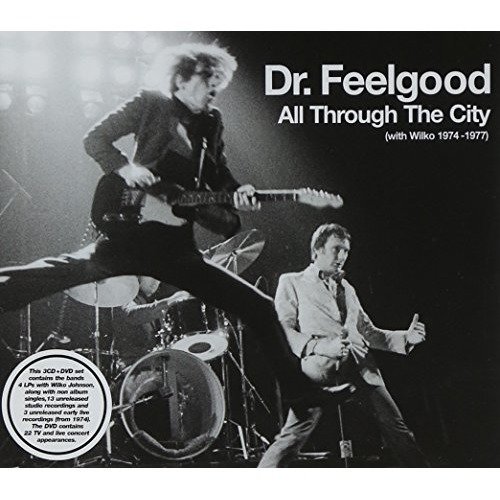
As a further tribute to the late great Wilko Johnson, here's a review of the Dr. Feelgood boxset All Through The City, which I wrote in 2012, for the now-defunct website, State.ie.

Dr. Feelgood

All Through The City (with Wilko 1974-1977)

(EMI)

Desmond Traynor

4/5

As the currently showing BBC 4 documentary series Punk Britannia persuasively hypothesises, the revolution of 1977 was the bastard offspring of the miscegenatious union of r’n’b and glam, when the pub rock and art college scenes met. From the former came most of the music, from the latter most of the look and attitude. Always somewhat Britcentric, the Beep elides the fact that as early as 1973 crazy Yanks like the New York Dolls were wearing women’s clothes while covering Sonny Boy Williamson and Bo Diddley songs. But then again, both Joe Strummer and Ian Dury attended art colleges and played in pub rock bands prior to New Wave apotheosis.

  Around the same time the Dolls were first trying on their high-heeled platform boots, Canvey Island’s Dr. Feelgood were tearing up the London pub scene with incendiary live shows which many seasoned gig goers were saying they hadn’t seen the likes of since the early days of The Who or The Stones. While scruffy off-the-peg suits were favoured as stage wear over silk or satin dresses, the same musical spirit animated them as that of their transatlantic tranny contemporaries. A brief band interview for Finnish television, at the end of the collection of live performances included in this marvelous new 3 CD + 1 DVD boxset of the band’s first four albums, plus unreleased demos, alternative versions, out-takes and live tracks, features the taciturn rhythm section of drummer John ‘The Big Figure’ Martin and bassist John B. Sparks (both of whom looked like burly bouncers you wouldn’t want to meet down a dark alley), the grimly polite singer Lee Brilleaux, and cocky young guitarist Wilko Johnson, who helpfully explains the r’n’b ‘revival’ thus: ‘It’s the best music. People have had six years of synthesisers and songs about hobbits. That’s for girls. People want to have a good time.’ As someone with a degree in Medieval English from Newcastle University, which he shrewdly kept quiet about, as well as considerable musical knowledge and ability, perhaps he was better placed to diagnose the deleterious influence of Tolkien on popular music than many would have given him credit for at the time.  

  They had their precursors, and their peers (Eggs Over Easy, Ducks Deluxe, Brinsley Schwarz, The Kursaal Flyers, Strummer’s 101ers, Dury’s Kilburn and the High Roads – even early Boomtown Rats), but they were the best. This was largely, in my opinion, down to Wilko’s wildly idiosyncratic guitar playing, whose self-confessed primary influence was Mick Green of The Pirates. Yet, although he was operating in a genre which thrives on notions of ‘passion’ and ‘feeling’, Wilko played like a machine, producing a weird r’n’b/motorik hybrid. Like forebears Otis Rush and Albert King, and the closer-to-home Jeff Beck, he eschewed the plectrum, his right hand a freestyle of fingers’n’thumb, conjuring choppy insistent rhythms and angular staccato lead lines, sometimes seemingly simultaneously. There’s less that separates the Feelgoods from Neu than you might think. The Man Machine, indeed. One shouldn’t, of course, overlook the solidness of the rhythm section itself in this process. Razor-sharp time-keeping was still the preserve of human beings in those days. Add to that the pent-up anger and frustration of Brilleaux, a front man who looked like he might hit you as soon as sing to you, which made him the scariest stage presence yet encountered in British live music, and who remained so until a sneering Johnny Rotten swaggered into the spotlight to unbeknowingly inherit his mantle, and the package was complete.

  What’s in the box? CD 1 has Down By The Jetty and Malpractice, both from 1975, the former the excellent re-master of the original mono mix released as a deluxe reissue in 2006 (thankfully still in mono), the latter, like the two albums on the succeeding CD, a new 2012 digital remaster.  CD 2 contains the peak and the valley, 1976’s Stupidity and 1977’s Sneakin’ Suspicion.  Produced, like the first two, by Vic Maile, who’d engineered The Who’s Live At Leeds, Stupidity is their masterpiece, one of the great live rock albums, made by a band who were always most at home in the live context. The rot set in with Sneakin’ Suspicion. Although signed to United Artists in Britain, they wound up on CBS in America, who felt their substantial promotional investment justified foisting their own choice of producer, studio veteran Bert De Coteaux, on the project. This resulted in an altogether too slick sheen to the sound, unsympathetic to a raw band like the Feelgoods. 

  There had been friction between Johnson and Brilleaux anyway. Wilko liked speed, and was partial to acid; the other three were serious drinkers (not that these recreational pursuits are necessarily mutually exclusive, but it proved so in this case). Jealously about ‘residuals’ may have also caused disputes, with Wilko doing the lion’s share of the songwriting. Whatever way you slice it, Johnson played on the album but never toured it, walking out of the sessions and subsequently forming the Solid Senders. As his replacement, the others drafted in John ‘Gypie’ Mayo, a perfectly adequate if rather more conventional r’n’b guitarist, who on later albums only served to illustrate how special Wilko had made Dr. Feelgood. Interestingly, some of the odds’n’sods on CD 3 are demos for Sneakin’ Suspicion, and tracks that were left off it, which show what a good album it could have been if the band had been left to its own devices. The DVD pulls together a variety of TV appearances (dig those cruel V-neck jumpers on The Geordie Scene’s audience) and live sets from shows at the Southend Kursaal (some of which wound up on Stupidity) and the Kuusrock festival in Finland. The package also includes a recent interview with Johnson, some natty comic strips and pics, plus a revelatory essay about their formative years, ‘The Breeding of Dr. Feelgood’, by poet Hugo Williams. (Another renowned poet, Tony Harrison, was apparently a huge mentor to Wilko at Newcastle, and later a close friend.)

  I saw them once, at the National Stadium in 1976 (don’t worry, I hadn’t even done my Inter Cert, as it was then known, at that stage) unfortunately just after Wilko had left. I saw the Solid Senders some years later, and have seen Wilco several times since. He played Whelan’s not so long ago. Good shows all, but together they must have been somethin’ else.

  The New York Dolls may have beaten their British counterparts to the punch by several years as progenitors of punk, but in this boxset you have a valuable document of one of the antecedents of British New Wave, the other strand of which was being provided by T Rex et al. The Feelgoods and Roxy Music? It’s a strange fusion, but that’s one of the great things about popular music: once you get beyond the fashion, it’s all there for you to choose your own particular pick’n’mix.


Friday, 11 December 2020

Lou Reed & Metallica - Lulu

Lou Reed & Metallica - Lulu

Universal

Desmond Traynor

4/5

To say that this album has received overwhelmingly negative reviews would be perhaps the most monumental understatement of the now nearly 12 year old century (apologies, but the hyperbole is sanctioned by Lou Reed’s own pre-release assertion to the effect that, ‘It’s maybe the best thing done by anyone, ever’ – a statement which, in itself, despite how far you gauge Lou’s tongue was planted in his cheek, might go some way towards explaining the widespread derision the project has been greeted with).  

  Most of the opprobrium focuses from the outset on the inherent incompatibility of the participants, and then continues, self-fulfillingly, to cite spurious examples of how Reed and Metallica sound not so much as though they are not on the same planet, but not even in the same room. All tosh, of course. Lou, after all, once claimed to have invented heavy metal, and contrary to what some of these know-all detractors would have you believe, I don’t think he was talking about the largely atonal Metal Machine Music, which I agree has little to do with the genre. More likely he had in mind 1974’s Rock’n’Roll Animal and 1975’s Lou Reed Live, both products of the same December 21st, 1973, concert at Howard Stein's Academy of Music in New York, where Dick Wagner’s and Steve Hunter’s humbucker-equipped guitars pump out the power chords and riffage in a way that has served as a template for the more melodic side of metal ever since. Indeed, the Loutallica versions of ‘Sweet Jane’ and ‘White Heat/White Light’, performed when the two first got together at the Rock’n’Roll Hall of Fame 25th anniversary concert in 2009, owe more than a little to those mid-70s predecessors. (It is a testimony to how great a song ‘Sweet Jane’ is that it can run the gamut of genre interpretation from these raucous arrangements to the Cowboy Junkies’ hushed campfire rendition, which Reed has called, ‘The most perfect realisation of that song I’ve ever heard.’) And while we’re at it, let’s not forget the interminable noise guitar work out ‘Like a Possum’, from 2000’s Ecstasy. Metallica, meanwhile, have more often than not cast themselves as the thinking person’s (let’s not be gender-specific about their fan base) hard rockers.  

 The source material is late 19th century Munich playwright Frank Wedekind’s Lulu plays, Earth Spirit and Pandora’s Box (the latter more well-known to contemporary audiences via G. W. Pabst’s 1929 silent film classic of the same name, starring bad girl Louise Brooks), which relate the story of a free-spirited stripper who becomes a social climber only to wind up a prostitute murdered by Jack the Ripper, whose uninhibited and amoral lifestyle bring tragedy to herself and those associated with her. Lulu is, incidentally, much in the local ether at the moment, between 3epkano’s live soundtrack for Pabst’s film at the IFI, and Camille O’Sullivan’s show The Lulu House at the recent Dublin Theatre Festival. 

  So, are the results of this collaboration as dire as they say? Absolutely not (and you saw that rhetorical answer/response coming a mile off, didn’t you?). ‘Brandenberg Gate’ kicks off proceedings, with ‘small town girl’ (as James Hetfield harmonises) Lulu arriving in the big smoke and soon tiring of her factory shifts, setting the agenda with ‘I’m just a small town girl who wants to give it a whirl/While my looks still hold me straight’. Lou gets to establish Berlin atmospherics, which hark back to his masterpiece of that title, by name-dropping obvious cultural reference points. A further agenda is set in ‘The View’, and continued throughout, most pointedly in ‘Little Dog’ and ‘Dragon’, which is Lulu’s zeitgeisty Nietzschean rejection of the conventional value system, especially the life goals expected of ‘decent’ women: ‘There is no more time for guilt/Or second guessing/Second guessing based on feeling’.

  Lyrically, BDSM is the recurring metaphor in all of Lulu, affording Reed the opportunity for a generational update on themes first explored all those years ago on the VU’s debut ‘Banana’ album, in ‘Venus in Furs’.  If lines such as ‘Pumping Blood’’s ‘I swallow your sharpest cutter like a coloured man’s dick’, or ‘Mistress Dread’’s ‘I beg you to degrade me/Is there waste I could eat?’, or ‘Frustration’’s ‘To be dead, to have no feeling/To be dry and spermless like a girl’ leave you nauseous, then this probably isn’t your idea of sexual recreation. One suspects the Marmite principle is going to apply with this one: there will be few neutrals. Disc 1 is written largely from Lulu’s perspective, while Disc 2 seems to be an angrily impotent (and impotently angry) male response, although point-of-view can be nebulously interchangeable, with first Disc closer ‘Cheat On Me’ the most reflexive of the bunch. The sadist needs the masochist as much as vice versa, and Lulu’s submission is a form of dominance.

  Musically, many of the songs begin with acoustic and/or orchestral tinkering before launching into full-blooded rockers. ‘Little Dog’ stays that way for its duration. As one who doesn’t listen to a whole lot of metal, I’m struck by how much, like blues, it uses the flattened fifth, or so-called Devil’s Note, for its effects. It’s not all super heavy either: ‘Iced Honey’ is straight, melodic barroom rock’n’roll, while 19 minute finale ‘Junior Dad’, a meditation on the disappointments of domesticity from the male point-of-view, shares tonal affinities with ‘Street Hassle’ and Songs For Drella’s ‘A Dream’, even if it goes on a lot longer.  

  Why all the hostility, then? I can only hypothesise that it stems from good old-fashioned snobbery, straight and inverted. One detects a sniffy assumption amongst the taste-making cognoscenti that poet and legendary art rocker Reed shouldn’t be demeaning himself by slumming with these raggedy, not-quite-house-trained, plebeian thrashers; while, from the other side of the fence, the notoriously conservative metal audience, who subscribe to a faith built upon simple pieties, don’t like to see their heroes getting all artily above themselves and up themselves. (One would think, however, that their worldview would be reinforced by a morality tale of a ballbreaking, never mind heartbreaking, femme fatale who comes to a bad end.) Pointing out the limitations of either case of tunnel-vision need not detain us here. One also suspects that a fair proportion of the naysayers may not have even given the discs a whirl, assuming from the outset that the whole shebang is an elaborate postmodern joke. Personally, I detect no irony in either of the collaborators’ professed admiration for the other.

  Not that Lulu is perfect, mind, not by a long chalk. Quite a few tracks are too long by half, particularly on Disc 2, seeking to bludgeon the listener into submission with the kind of dominance that depends on relentlessly lengthy repetition rather than genuinely inventive intensity. Pushing 90 minutes when an hour would have sufficed, the cliché about how an average double album would have been a great single album could certainly be invoked here. Also, Reed’s lyrics, for all that they may seek to, and arguably even successfully do, epater le bourgeois, too often come across as half-baked, repetitious, and lack a narrative arc. These considerations aside, Lulu is, while not quite the best thing either party has ever done, certainly the best new material either has come up with in some time, and deserves more of a hearing than the critical scorn it has been met with will probably allow it to receive.   


Saturday, 28 December 2019

Albums of the Year 2019


I don’t really feel qualified to compile any kind of authoritative or exhaustive list this year, as there is such a lot of new music I haven’t heard, and I’ve spent a good amount of my 2019 listening time listening to music that wasn’t released in 2019. But, in the nick of time, here goes. The order doesn’t really mean much, especially as you get nearer the bottom, and could easily change depending on how much more I listen to the works and live with them (or even which ones I’ve listened to most recently). So it’s all a bit arbitrary. Judging from other lists here, it looks like I have a lot of catching up to do. 

1)     The Delines – The Imperial 

2)     Bob Dylan – The Rolling Thunder Revue: The 1975 Live Recordings

3)     Sunn O))) – Life Metal 

4)     black midi – Schlagenheim

5)     Various Artists – Kankyō Ongaku: Japanese Ambient, Environmental & New Age Music 1980 -1990

6)     Hildur Guðnadóttir – Chernobyl [Original TV Soundtrack]

7)     The Flaming Lips – King's Mouth: Music and Songs

8)     Angel Olsen – All Mirrors 

9)     Fontaines DC – Dogrel

10)  Purple Mountains – Purple Mountains

11)  Leonard Cohen – Thanks For The Dance

12)  Oh Sees – Face Stabber

13)  King Gizzard and The Lizard Wizard – Infest The Rats’ Nest

14)  King Gizzard and The Lizard Wizard – Fishing For Fishies 

15)  Swans – Leaving Meaning 

16)  The Quiet Temple – The Quiet Temple

17)  Nilüfer Yanya – Miss Universe

18)  Chromatics – Closer To Grey

19)  Ohtis – Curve of Earth

20)  Richard Hawley – Further


Bubbling Under:

Joan as Police Woman – Live at the BBC

Sharon Van Etten – Remind Me Tomorrow 

The Felice Brothers – Undress

Robert Forster – Inferno

Slowthai – Nothing Great About Britain


Friday, 13 December 2013

Albums Of The Year 2013

So it's time for my stupid End of Year lists. First up:

Albums of the Year 2013         
                                                              
  1. John Murry – The Graceless Age
  2. My Bloody Valentine – MBV
  3. White Denim – Corsicana Lemonade
  4. Sean Millar – C48
  5. Paul McCartney – New
  6. The Flaming Lips – The Terror
  7. Gary Clark Jr – Blak and Blu
  8. David Bowie – The Next Day
  9. Julia Holter – Loud City Song
10. Low – The Invisible Way

Bubbling Under (No particular order):

Yeah Yeah Yeahs – Mosquito
Jonathan Wilson – Fanfare
Anna Calvi – One Breath
Nick Cave and the Bad Seeds – Push The Sky Away
John Grant – Pale Green Ghosts
Steve Earle – The Low Highway

Thee Oh Sees – Floating Coffin


Thursday, 24 October 2013

Okkervil River - The Silver Gymnasium


Okkervil River

The Silver Gymnasium

ATO

Desmond Traynor

3/5

Okkervil River’s new album, their seventh, is like several of their previous recordings, a concept album, in that it takes us back to a 1980s childhood and adolescence, specifically that of mainman Will Sheff, and is set in his hometown of Meriden, New Hampshire. This is the most personal songwriting Sheff has done to date, although it is still far from confessional. Instead, the narrator of most of these songs comes across as an uncomfortable observer, looking back to a more innocent yet also unsettling time, when mistakes were made, emotions were still raw, and life was being learned about. Some of his fellows, as explored in songs like ‘Lido Pier Suicide Car’ and ‘Walking With Frankie’, didn’t make it.

  The ’80s are now almost universally derided as ‘the decade that taste forgot’, but it’s worth remembering it wasn’t all shoulder pads and mullets. This is, after all, the time when the likes of R.E.M., The Smiths and The Go Betweens flourished. But Sheff and his early adolescent chums wouldn’t have discovered those bands quite yet, still stuck as they were with a nascent MTV. There’s even an affectionate and evocative mention of ‘the greatest song that you taped off the radio/Play it again and again (it cuts off at the ending, though)’ in ‘Down Down The Deep River’, one of the more epic tracks here, replete with a synth keyboard solo redolent of Cheap Trick. Period references are present but not heavy-handed, for example the VCR and Atari of ELO-ish opener ‘It Was My Season’, the Walkman of ‘Where The Spirit Left Us’. There are shades of the suburban unease of movies like Donnie Darko, Dazed and Confused, even Blue Velvet. In fact, the nearest point of comparison, thematically if not musically, might be Arcade Fire’s 2010 album The Suburbs, or even their first (and still best), 2004’s Funeral. But Okkervil River are a much more aware, complex proposition than Montreal’s finest, since although Win Butler got it right first time out, his constant references to ‘the kids’ by the time he got to The Suburbs quickly grew tiresome. Sheff is too self-conscious a writer to ever appear so gauche.

  Therein, in a way, lies the problem with The Silver Gymnasium. Okkervil River have always been a cerebral outfit, easy to admire but harder to love, as they say. Sheff is frequently praised for being ‘literate’, but too often he is just ‘wordy’, which is not quite the same thing. One gets the sense he likes you to know that he’s the smartest guy in the room. Don’t get me wrong: I’m not naively arguing that you can’t be clever and rock’n’roll at the same time. But imagine if Roky Erikson had been backed on his comeback True Love Cast Out All Evil by an outfit like White Denim or Wooden Shjips, rather than Sheff (whose heart is clearly in the right place) & Co., and maybe you’ll get what I’m driving at.

  This uptightness, for want of a better word, isn’t helped here by the very clean production work of John Agnello, a man who helmed several projects by ’80s luminaries like Cyndi Lauper and John Mellencamp. Still, this is Okkervil River’s first major label album, for ATO, having jumped up from Jagjaguwar, so maybe they’re in search of a wider audience. The compromise, if such it is, could prove counterproductive, however.

  The standout track is the penultimate, ‘All The Time Every Day’, where the passion of the vocal delivery of verse questions and chorus responses gets into stride with the emotions expressed. Otherwise, while The Silver Gymnasium has much to recommend it, it is far from the group’s best. Interested parties would be well advised to start elsewhere, with The Stage Names or The Stand Ins, or even better, Black Sheep Boy or I Am Very Far